Tell us about the job
Takes about a minute. No obligation.
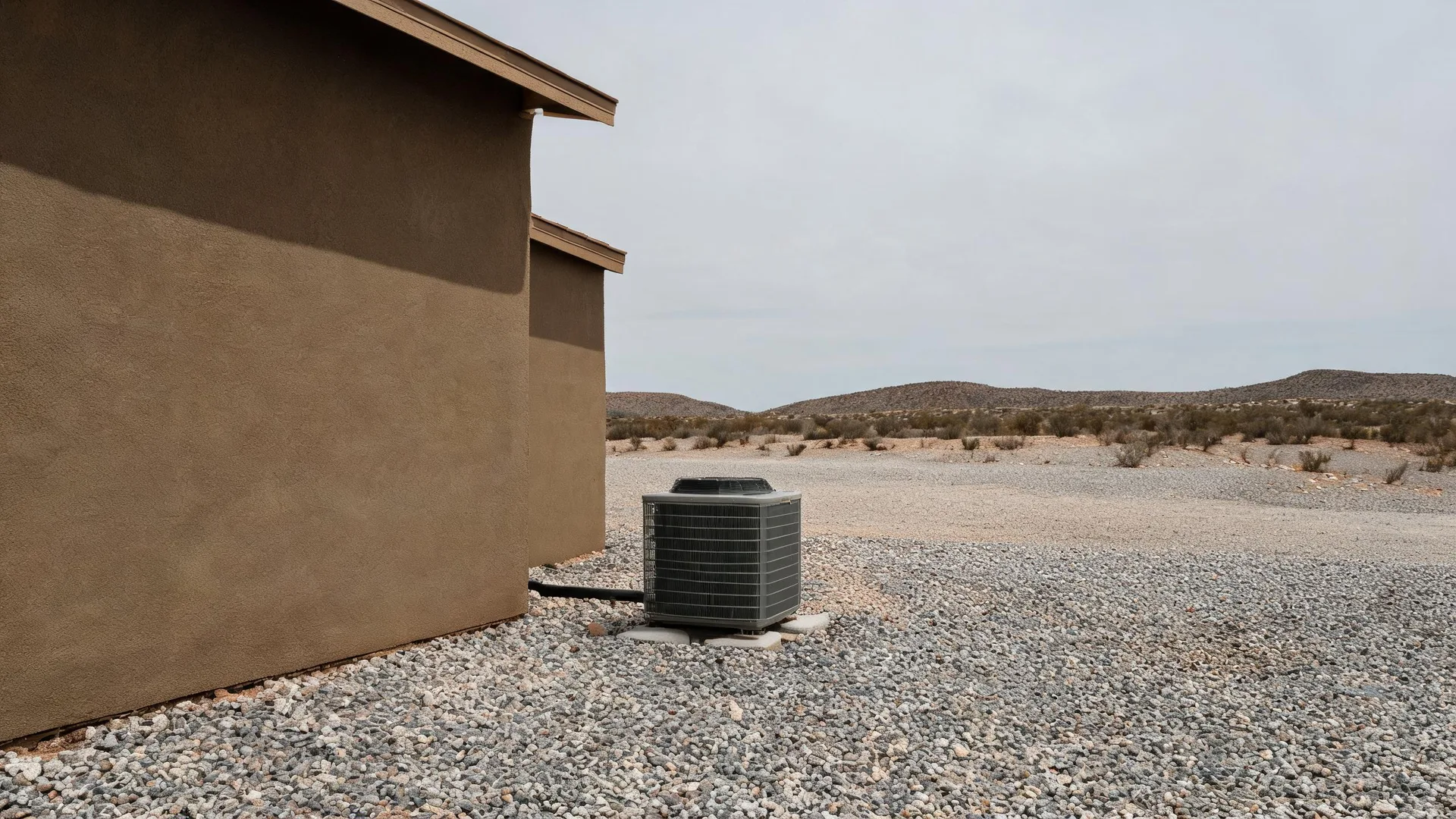
A contractor diagnosing a central AC problem in Yavapai County starts with the compressor circuit: the contactor, the capacitor, and the condenser fan motor. Homes in Yavapai County, AZ run cooling about four months a year, from June through September. Those components start and stop every time the system calls for cooling, and a full summer of that cycling leaves marks. Contactors pit, capacitors weaken, and fan motors run hot. A system that was marginal when it was installed gives out sooner under that kind of load than it would if it sat idle half the year. The refrigerant charge and the coil condition matter too, but worn electrical components are what a licensed contractor finds first in this area.
Ductwork in stock this age was put in for whatever system ran first, and the refrigerant lines, filter housings, and blower assemblies that went with it are not always what sits there now. Half the homes in Yavapai County, Arizona were built in 1995 or earlier (2020-2024 ACS 5-year). When a contractor opens a unit in a house like this, the question that shapes the job is whether the failed component can still be sourced. If the part is still made, the repair moves quickly. If it has been superseded, the contractor is pricing what is actually available, which may mean an adapted replacement that fits the existing configuration or a conversation about a different path forward.
The Parts of a Central AC a Contractor Checks First
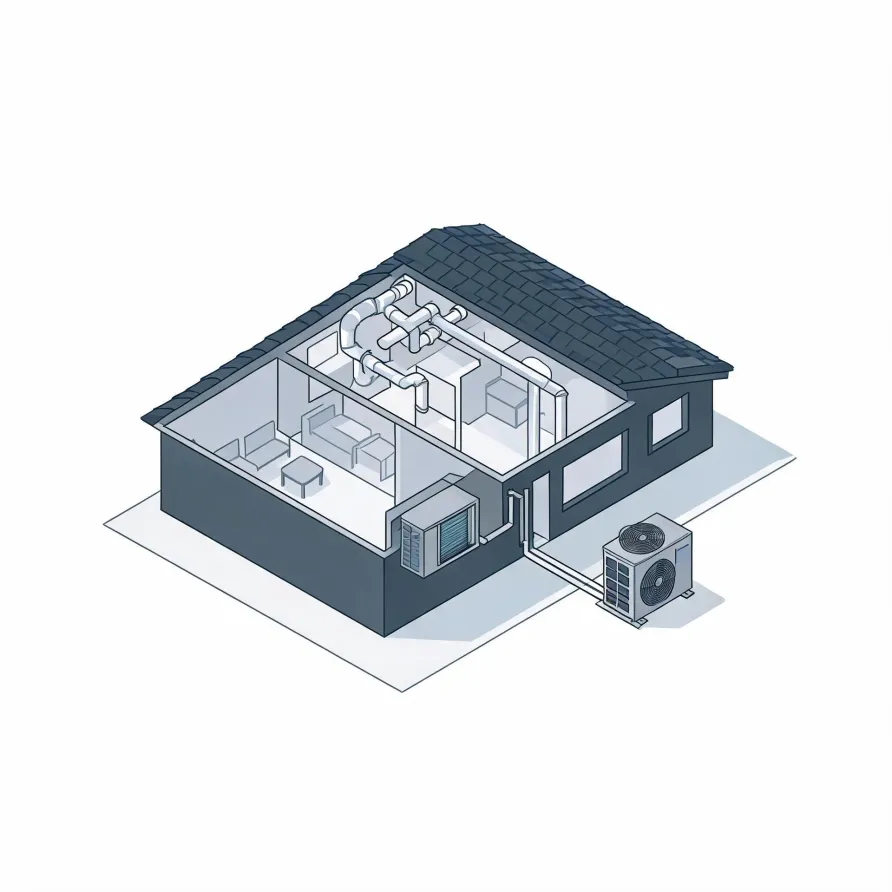
The outdoor condenser unit sits outside the house, usually on a concrete pad along an exterior wall, and it is where heat gets released to the outside air. The indoor air handler or furnace-mounted coil sits inside, most often in a utility closet, attic, or basement, and it is where the refrigerant does its work on the air moving through your home. When either of these units is the source of a problem, a contractor can usually tell quickly from what the system is doing or failing to do.
The copper refrigerant lines run between the two units, carrying refrigerant back and forth, and a leak or blockage anywhere along them affects the whole system. The thermostat on your wall is the starting point a contractor checks before anything else, because a fault there can look like a fault almost anywhere else. The electrical disconnect box near the outdoor unit and the capacitors and contactors inside it are frequent failure points as well.
The drawing shows a typical layout, and a licensed contractor will determine which components and conditions apply to your specific house.
Get matched in Yavapai CountyYavapai County by the Numbers
180 severe weather events were recorded in Yavapai County, Arizona between 2015 and 2024.
NOAA National Centers for Environmental Information, Storm Events Database, bulk CSV export, events 2015-01-01 through 2024-12-31.Half the homes in Yavapai County, Arizona were built in 1995 or earlier (2020-2024 ACS 5-year).
U.S. Census Bureau, 2020-2024 American Community Survey 5-Year EstimatesYavapai County, Arizona holds 126,095 housing units (2020-2024 ACS 5-year).
U.S. Census Bureau, 2020-2024 American Community Survey 5-Year EstimatesOwners occupy 75.1% of the occupied homes in Yavapai County, Arizona (2020-2024 ACS 5-year).
U.S. Census Bureau, 2020-2024 American Community Survey 5-Year EstimatesCentral AC Repair Rules & Standards for Yavapai County, Arizona9 sourced regulations and standards
What the repair visit looks like
Split-system central air conditioners rated below 45,000 Btu/h manufactured on or after January 1, 2023 must meet a federal minimum of 13.4 SEER2.
Split-system central air conditioners rated at or above 45,000 Btu/h manufactured on or after January 1, 2023 must meet a federal minimum of 13.4 SEER2.
Split-system central air conditioners manufactured between January 1, 2015 and December 31, 2022 had to meet 13 SEER, the metric that preceded SEER2.
Single-package central air conditioners manufactured on or after January 1, 2023 must meet a federal minimum of 13.4 SEER2.
Space-constrained central air conditioners manufactured on or after January 1, 2023 must meet a federal minimum of 11.7 SEER2.
Federal efficiency standards for split-system central air conditioners and heat pumps are set on each certified combination of outdoor unit and indoor coil rather than on the outdoor unit alone.
Residential and light commercial air conditioning and heat pump systems assembled in the field, including mini-splits and unitary systems, may not be installed on or after January 1, 2025 using a refrigerant with a global warming potential above 700.
A field-assembled system whose specified components were all manufactured or imported before January 1, 2025 carries no installation compliance date under the refrigerant restrictions and may still be installed.
Licensing and Legal Requirements in Yavapai County, Arizona
Arizona requires a contractor licence in good standing: it is unlawful to engage in the business of contracting, to bid, or to act or hold yourself out as a contractor without one.
Severe Weather Events in Yavapai County
Extreme weather puts real hours on AC equipment. Repair demand in Yavapai County tracks conditions here, not conditions elsewhere, which is why local weather history belongs on a page about local repair work.
180 severe weather events, 2015–2024. Source: NOAA National Centers for Environmental Information, Storm Events Database.