Tell us about the job
Takes about a minute. No obligation.
The compressor in a Santa Cruz County home starts and stops through every day of a real summer load, and by the time a homeowner calls for repair, those parts have already logged seasons of hard cycling. Homes in Santa Cruz County, AZ run cooling about four months a year, from June through September. Contactors pit, capacitors weaken, and condenser fan motors run hot across that stretch before any fault becomes obvious. A contractor quoting a repair here checks those components before anything else, because they carry the load directly and fail in a predictable order.
Ductwork and refrigerant lines put in decades ago were built around systems that manufacturers stopped supporting long before the current equipment went in. Half the homes in Santa Cruz County, Arizona were built in 1991 or earlier (2020-2024 ACS 5-year). When a contractor opens a unit in a house this age, the question that shapes the repair bill is whether the components it needs are still made, and if they are, whether sourcing them adds time and cost the homeowner was not expecting. A unit running on a refrigerant that is now restricted, or drawing a part that left catalogs years ago, changes the scope of what a repair actually is.
The Parts of a Central AC a Contractor Checks First
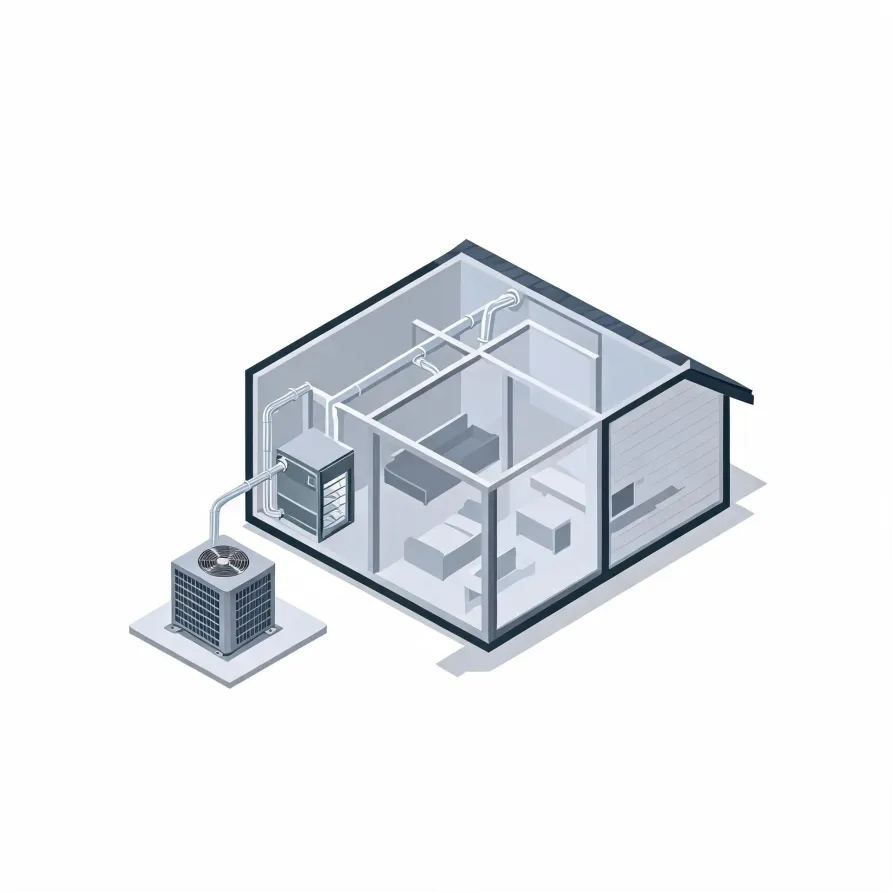
The outdoor condenser unit sits outside the house, usually on a concrete pad at ground level, and it holds the compressor and condenser coil. These are the pieces a contractor reaches first when a system stops cooling, because a failed compressor or a fouled coil will shut down the whole system. The air handler or furnace cabinet, mounted indoors in a closet, basement, or utility room, holds the evaporator coil and the blower fan that moves air through the house.
The refrigerant lines run between the two cabinets, and the service valves and copper fittings along those lines are common places for leaks to show up. The thermostat on the wall controls when the system runs, and a wiring fault or a failed sensor there can mimic problems that appear to come from deeper in the system.
The drawing shows a typical central AC layout, and a licensed contractor determines which components and connections apply to your specific home.
Get matched in Santa Cruz CountySanta Cruz County, by the numbers
86 severe weather events were recorded in Santa Cruz County, Arizona between 2015 and 2024.
NOAA National Centers for Environmental Information, Storm Events Database, bulk CSV export, events 2015-01-01 through 2024-12-31.Half the homes in Santa Cruz County, Arizona were built in 1991 or earlier (2020-2024 ACS 5-year).
U.S. Census Bureau, 2020-2024 American Community Survey 5-Year EstimatesSanta Cruz County, Arizona holds 19,232 housing units (2020-2024 ACS 5-year).
U.S. Census Bureau, 2020-2024 American Community Survey 5-Year EstimatesOwners occupy 69.3% of the occupied homes in Santa Cruz County, Arizona (2020-2024 ACS 5-year).
U.S. Census Bureau, 2020-2024 American Community Survey 5-Year EstimatesCodes & Standards Behind Central AC Repair in Santa Cruz County, Arizona9 sourced rules and standards
What HVAC Repair Looks Like in Santa Cruz County
Split-system central air conditioners rated below 45,000 Btu/h manufactured on or after January 1, 2023 must meet a federal minimum of 13.4 SEER2.
Split-system central air conditioners rated at or above 45,000 Btu/h manufactured on or after January 1, 2023 must meet a federal minimum of 13.4 SEER2.
Split-system central air conditioners manufactured between January 1, 2015 and December 31, 2022 had to meet 13 SEER, the metric that preceded SEER2.
Single-package central air conditioners manufactured on or after January 1, 2023 must meet a federal minimum of 13.4 SEER2.
Space-constrained central air conditioners manufactured on or after January 1, 2023 must meet a federal minimum of 11.7 SEER2.
Federal efficiency standards for split-system central air conditioners and heat pumps are set on each certified combination of outdoor unit and indoor coil rather than on the outdoor unit alone.
Residential and light commercial air conditioning and heat pump systems assembled in the field, including mini-splits and unitary systems, may not be installed on or after January 1, 2025 using a refrigerant with a global warming potential above 700.
A field-assembled system whose specified components were all manufactured or imported before January 1, 2025 carries no installation compliance date under the refrigerant restrictions and may still be installed.
Licensing and Legal Requirements in Santa Cruz County, Arizona
Arizona requires a contractor licence in good standing: it is unlawful to engage in the business of contracting, to bid, or to act or hold yourself out as a contractor without one.
Severe Weather Events in Santa Cruz County
Extreme weather puts AC systems under strain that ordinary use does not. Repair frequency in Santa Cruz County is shaped by local conditions, which is why this data belongs alongside any honest look at what keeps equipment running here.
86 severe weather events, 2015–2024. Source: NOAA National Centers for Environmental Information, Storm Events Database.